
Introduction
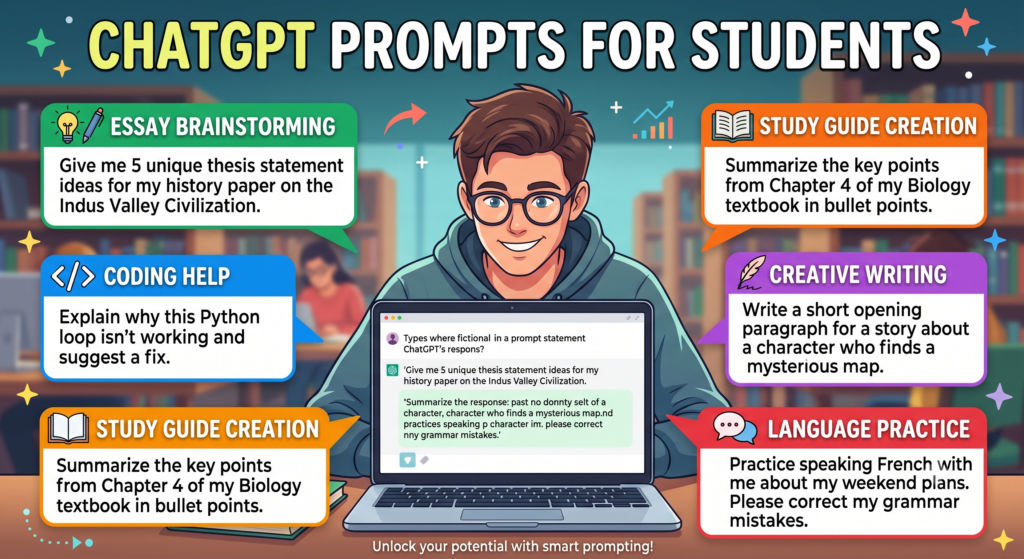
ChatGPT Prompts for Students Artificial intelligence has become a practical learning tool for students at every education level. Instead of replacing learning, ChatGPT can help students organize ideas, understand difficult concepts, improve writing, summarize lengthy materials, and prepare for exams more efficiently. The quality of the results depends largely on the prompts you use.
This guide explores ChatGPT prompts for students that can support everyday learning, whether you’re in school, college, or university. You’ll also learn how to write better prompts, avoid common mistakes, and use AI responsibly in your academic work.
What Are ChatGPT Prompts?
A ChatGPT Prompts for Students is the instruction or question you give to the AI. A clear prompt produces a more useful answer than a vague one.
For example:
Basic Prompt
Explain photosynthesis.
Better Prompt
Explain photosynthesis in simple language suitable for a 10th-grade student. Include a real-life example and finish with five quiz questions.
Adding details such as your education level, preferred format, and desired outcome helps ChatGPT provide more relevant responses.
Why Students Use ChatGPT
Students use ChatGPT for many academic tasks, including:
- Understanding complex topics
- Writing essay outlines
- Summarizing textbooks
- Creating revision notes
- Solving mathematics step by step
- Learning programming concepts
- Practicing interview questions
- Improving grammar and vocabulary
- Generating presentation ideas
- Preparing for exams
When used responsibly, ChatGPT Prompts for Students becomes a study assistant rather than a shortcut.
Best ChatGPT Prompts for Homework
Here are prompts that can help with homework:
- Explain this topic as if I have never studied it before.
- Break this chapter into easy-to-understand notes.
- Give me examples with simple explanations.
- Create five practice questions with answers.
- Check my homework for grammar and factual mistakes.
- Explain where my solution is incorrect and how to improve it.
These prompts encourage understanding rather than copying answers.
ChatGPT Prompts for Essay Writing
Writing essays becomes easier when you ask specific questions.
Useful prompts include:
- Create an essay outline on this topic.
- Suggest five strong thesis statements.
- Improve the introduction without changing the meaning.
- Rewrite this paragraph in academic English.
- Add evidence-based arguments to strengthen my essay.
- Suggest a conclusion that summarizes the main points.
Always review and edit AI-generated content before submitting it.
Prompts for Research
Research requires reliable organization.
Examples:
- Explain the background of this topic.
- Compare these two theories.
- Summarize this research paper in simple English.
- List important concepts I should study.
- Create study notes from this article.
- Generate discussion questions for classroom debate.
Exam Preparation Prompts
Effective revision is about practice.
Try prompts such as:
- Create a 30-day study plan for my exam.
- Generate multiple-choice questions on this chapter.
- Test me one question at a time.
- Explain incorrect answers after I respond.
- Create flashcards from these notes.
- Give me memory techniques for important definitions.
Programming Prompts
Students learning coding can use prompts like:
- Explain this Python code line by line.
- Find the bug in my JavaScript program.
- Write beginner-friendly comments for this code.
- Suggest a more efficient algorithm.
- Create coding exercises with solutions.
Learning why code works is more valuable than copying it.
Language Learning Prompts
Students studying English or another language can ask ChatGPT Prompts for Students to:
- Correct my grammar.
- Improve my vocabulary.
- Translate this paragraph naturally.
- Create a conversation for daily practice.
- Explain difficult words with examples.
- Generate pronunciation tips.
Time Management Prompts
Productivity matters as much as knowledge.
Useful prompts include:
- Create a weekly study timetable.
- Prioritize my assignments.
- Suggest a Pomodoro study schedule.
- Build a revision plan for the next two weeks.
- Help me balance study and extracurricular activities.
Tips for Writing Better ChatGPT Prompts
To get better responses:
- Be specific.
- Mention your grade level.
- Explain your goal.
- Request examples.
- Ask for step-by-step explanations.
- Request tables or bullet points if needed.
- Continue asking follow-up questions.
The clearer your instructions, the more useful the output.
Common Mistakes Students Should Avoid
Avoid relying entirely on AI-generated content. Instead:
- Verify important facts.
- Check references independently.
- Rewrite answers in your own words.
- Follow your institution’s academic integrity rules.
- Use ChatGPT to learn, not to plagiarize.
Responsible use develops stronger skills over time.
Frequently Asked Questions
Can students use ChatGPT for homework?
Yes. It can explain concepts, suggest ideas, and provide practice questions. Students should still complete their own work.
Is ChatGPT good for exam preparation?
Yes. It can generate quizzes, summaries, flashcards, and revision schedules.
Can ChatGPT improve writing?
It helps with grammar, structure, vocabulary, and clarity, but students should review the final version themselves.
Is using ChatGPT considered cheating?
That depends on your school’s policies and how you use it. Using it as a learning aid is generally different from submitting AI-generated work as your own.
Conclusion
ChatGPT has become a valuable educational assistant for students who want to study more efficiently. Whether you need help understanding difficult concepts, writing essays, preparing for exams, learning programming, or improving language skills, well-written prompts make a significant difference.
The key is to use ChatGPT Prompts for Students as a learning partner. Ask detailed questions, verify important information, and apply what you learn independently. Students who use thoughtful prompts often gain a deeper understanding of their subjects while improving their productivity and confidence.