
Best Hosting for Fast Indexing Ever wondered why you can publish a masterpiece of an article, push it live, and then sit around waiting days—or even weeks—for it to show up on Google? Meanwhile, the big-name sites in your niche seem to get their new pages indexed in a matter of minutes. You have optimized your sitemaps, you are requesting manual indexing in Google Search Console, and you are using the best keywords. So, what gives?
The hidden bottleneck is almost always your web hosting. Most people view web hosting as just a digital storage locker where their website files live, but search engine bots view it as the gateway to your content. If that gateway is sluggish, poorly configured, or constantly dropping connections, search engine crawlers will get frustrated and leave.
If you want your content discovered the moment it drops, you need to understand the mechanics of how your server infrastructure dictates your visibility. Choosing the best hosting for fast indexing is not just about raw speed; it is about providing search engine spiders with an frictionless, lightning-fast pathway to crawl, render, and catalog your pages before your competitors do.
Quick Facts: How Web Hosting Fuels Fast Indexing
Before we dive deep into the technical layout, let’s look at the baseline specifications required to guarantee rapid Best Hosting for Fast Indexing. If your current provider does not hit these benchmarks, your SEO strategy is operating with a massive handicap.
| Hosting Feature | Target Metric for Fast Indexing | Why It Matters for SEO |
| Time to First Byte (TTFB) | Under 200ms (Excellent) | Determines how fast Googlebot receives the first byte of data. |
| Server Architecture | LiteSpeed or Highly Optimized NGINX | Handles massive concurrent crawl requests without dropping connections. |
| Uptime Guarantee | 99.99% Minimum | Prevents 5xx server errors when search engine bots attempt to crawl. |
| HTTP Protocol Support | HTTP/2 or HTTP/3 Enabled | Allows multiplexing so bots can download multiple assets simultaneously. |
| Database Technology | NVMe SSD Storage | Accelerates database queries, allowing faster dynamic page rendering. |
The Invisible Link Between Your Server and Googlebot
To understand why you need the best hosting for fast indexing, you have to look at how search engine spiders actually operate. Google does not have infinite resources to dedicate to your website. Instead, it assigns your site a highly specific “crawl budget.” This budget is a combination of the crawl rate limit—how much simultaneous fetching your server can handle without blowing up—and the crawl demand, which is based on how popular and frequently updated your site is.
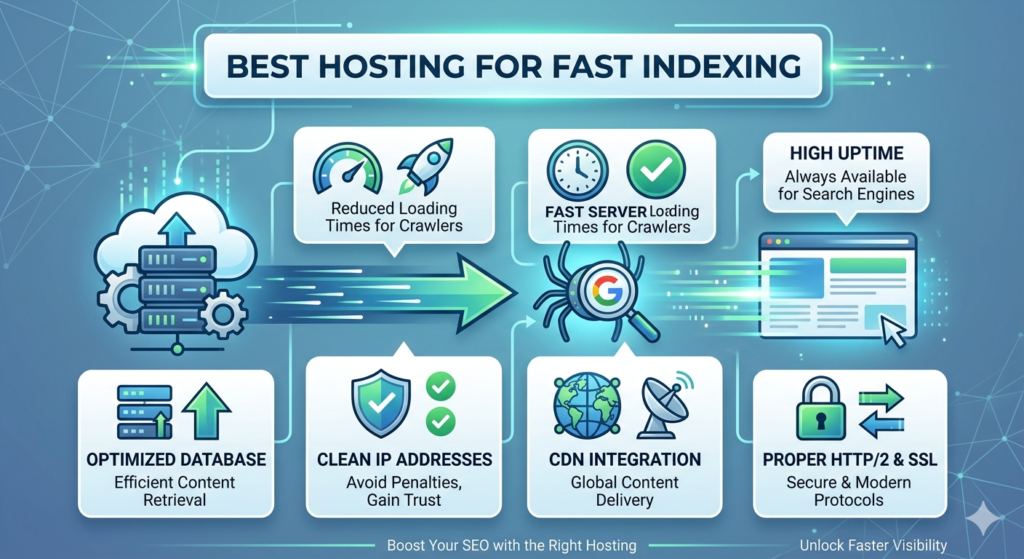
When Googlebot lands on a premium, high-performance host, it encounters a remarkably low Time to First Byte (TTFB). The server responds instantly, handing over the requested HTML document without hesitation. Because the server is fast and stable, Googlebot realizes it can crawl dozens of pages per second without causing a server crash. It expands your practical crawl budget, allowing its spiders to venture deeper into your architecture and instantly index newly published or updated content.
Conversely, cheap, unoptimized shared hosting does the exact opposite. When a search spider hits a congested server, the TTFB spikes, pages take forever to respond, and the server might even return intermittent 500 or 503 errors. Googlebot immediately throttles its crawl rate to avoid knocking your site offline. It cuts its visit short, leaves your new pages undiscovered, and moves on to a site that can handle the load. That is why your choice of provider dictates your indexation speed.
Top Hosting Architecture Picked for Lightning-Fast Discovery
When hunting for the best hosting for fast indexing, you cannot rely on generic marketing fluff. You need to look under the hood at the exact server architecture being deployed. The gold standard for modern, search-optimized publishing relies heavily on edge caching, containerized resources, and elite server stacks like LiteSpeed and advanced NGINX setups.
Cloudways (Scalable Managed Cloud Ecosystem)
Cloudways operates differently than standard hosting companies because it acts as a managed layer over the world’s most powerful cloud infrastructure networks, including DigitalOcean, AWS, and Google Cloud Platform. By breaking away from traditional shared environments, Cloudways grants your website dedicated server resources (RAM and CPU). This means when Googlebot initiates an aggressive crawl, your site does not have to share processing power with thousands of neighboring sites.
The real secret weapon inside Cloudways for accelerating indexation is their custom optimization stack, known as Breeze, paired with advanced server-side caching like Redis and Varnish. This infrastructure ensures that your server response time remains completely flat, even under heavy parallel request loads. When Google’s rendering engine attempts to execute complex JavaScript on your pages, the dedicated cloud nodes process the scripts instantly, resulting in flawless, rapid indexation.
Hostinger (The High-Performance Budget Powerhouse)
Hostinger has completely redefined what budget-conscious web masters can expect from a hosting provider by integrating LiteSpeed Web Servers across their entire product fleet. LiteSpeed is a high-performance drop-in replacement for old-school Apache servers, designed to handle massive concurrency with minimal memory usage. For an SEO professional, this means your server can handle simultaneous human traffic and intense search bot crawling without breaking a sweat.
Hostinger couples this LiteSpeed framework with the LiteSpeed Cache (LSCache) engine and advanced NVMe SSD drives. This allows your site to serve pre-rendered static snapshots of your pages to search engine bots in milliseconds. By minimizing the time it takes for a bot to digest your content, Hostinger ensures your crawl budget is utilized with maximum efficiency, making it arguably the best budget-friendly hosting for fast indexing available today.
SiteGround (Google Cloud Infrastructure with Advanced In-House Tuning)
SiteGround builds its hosting platform directly on top of the ultra-reliable Google Cloud infrastructure, giving you access to one of the fastest and most stable networks on the planet. Because your site runs on the same global network that powers Google itself, network latency drops to near zero. This gives your site an immediate structural advantage when it comes to raw server connectivity and data transfer speeds.
What makes SiteGround truly exceptional for fast content discovery is their proprietary performance engineering. They feature an in-house “SuperCacher” system that utilizes NGINX direct delivery to serve cached assets straight out of the server’s memory. Furthermore, their custom PHP setup processes code up to 30% faster than standard configurations. This rapid execution means search bots can zip through your internal link structures seamlessly, Best Hosting for Fast Indexing new URLs almost immediately after you hit publish.
Essential Server Features That Trigger Immediate Crawling
If you want to maintain a high-velocity indexation pipeline, your hosting environment must actively provide specific protocols that modern search engines rely on to discover and parse content safely and efficiently.
HTTP/3 and Multiplexed Data Streams
Older web hosting environments still rely on ancient HTTP/1.1 protocols, which force search engine bots to download your site assets (CSS, JavaScript, images) one by one in a long queue. Modern, SEO-optimized Best Hosting for Fast Indexing must support HTTP/2 or the cutting-edge HTTP/3 protocol. These modern standards utilize multiplexing, allowing Googlebot to download dozens of assets simultaneously over a single open connection.
When a bot can download your entire page asset portfolio in a single, unified burst, the total rendering time drops dramatically. Since Google’s indexation process relies heavily on a two-stage approach—first reading the HTML, then rendering the visual layout—slashing the rendering time means your content moves from the discovery queue to the live search engine results pages (SERPs) much faster.
Server-Level Object Caching
Most basic webmasters rely entirely on front-end WordPress plugins to handle their caching, but true technical SEOs know that real speed happens at the server level. The best hosting for fast indexing provides native access to object caching mechanisms like Redis or Memcached. These tools cache your database queries rather than just your static visual pages.
[Search Engine Bot] —> [Server-Level Cache (Redis/LSCache)] —> [Instant HTML Response]
|
(By-passes heavy
Database Queries)
Every time a search bot requests a page, your site normally has to ask the database for the post content, the category tags, the author info, and the layout parameters. This process causes CPU usage to skyrocket. Object caching stores those database answers in the server’s RAM. When Googlebot crawls your site, the server serves up the data instantly without having to rebuild the page from scratch every single time, maintaining an optimal crawl environment.
Global Data Center Proximity and Anycast CDNs
Physical distance creates latency, and latency kills crawl speed. If your target audience and the search engine data centers are in North America, but your hosting provider keeps your site on a server in Europe, every single data packet has to travel across an ocean. This adds precious milliseconds to your TTFB, signaling to search spiders that your site is sluggish.
The Best Hosting for Fast Indexing providers mitigate this by offering a vast footprint of global data center locations alongside integrated Anycast Content Delivery Networks (CDNs). This architecture clones your site’s static assets across a worldwide matrix of edge servers. When an Best Hosting for Fast Indexing bot attempts to access your site, it is automatically routed to the absolute closest physical server node, driving your latency down to the absolute absolute minimum.
Technical Optimization: Fine-Tuning Your Host for Maximum Visibility
Securing an elite web host is the foundational step, but you must also properly configure your hosting environment to extract every bit of Best Hosting for Fast Indexing performance possible.
- Implement Server-Side Compression (Gzip/Brotli): Ensure your hosting control panel has Brotli or Gzip compression actively turned on. This compresses your site’s text assets by up to 70%, allowing crawl bots to download and read your raw code significantly faster.
- Enforce HTTP/2 or HTTP/3 Protocol Execution: Check your server configuration files or CDN settings to force connections over HTTP/3. This prevents search engine spiders from dropping down to slower legacy transfer protocols during aggressive crawls.
- Optimize PHP Memory Allocations: Out-of-the-box hosting environments often cap your PHP memory limit at a meager 64MB or 128MB. Go into your Best Hosting for Fast Indexing settings (via your php.ini or wp-config.php file) and boost this to at least 256MB or 512MB to keep your server from choking when processing large site structures.
- Isolate and Protect Your IP Reputation: Avoid dirt-cheap, unmoderated shared hosting environments where your site shares a single IP address with spammy, black-hat link networks. If your server neighbors are violating search guidelines, your own crawl priority can be severely compromised.
Frequently Asked Questions (FAQ)
Can bad hosting completely stop Google from indexing my website?
Yes, absolutely. If your web hosting experiences frequent micro-downtimes or routinely suffers from server capacity overloads, it will return HTTP 5xx status codes to search spiders. When Google encounters repeated server errors, it pulls back its crawlers to protect your site traffic. If these errors persist over a few days, Google will actively de-index your existing pages and completely halt the discovery of any new content.
What is the ideal Time to First Byte (TTFB) for fast indexing?
For optimal search bot indexation, your TTFB should consistently clock in under 200 milliseconds. Anything under 100ms is considered elite tier and is typically achieved using high-performance cloud Best Hosting for Fast Indexing or advanced server-side edge caching. If your TTFB wanders north of 500ms, your server is officially bottlenecking your search visibility and dragging down your Core Web Vitals performance.
Does upgrading to dedicated or cloud hosting instantly fix indexing issues?
Upgrading to a dedicated server or cloud ecosystem provides the raw computing power and processing bandwidth required to support fast crawling, but it is not a magic wand. If your internal site architecture is completely broken, filled with redirect loops, bloated image file sizes, unoptimized JavaScript execution, or flawed canonical tags, your indexation will still lag. High-quality Best Hosting for Fast Indexing provides the required runway, but your technical on-page SEO must still be clean.
How does server location impact the speed of search engine indexing?
Search engines run their crawl systems out of major global data center clusters. If your physical web server is located thousands of miles away from the primary data hubs used by search engine spiders, data packet routing latency will slow down the transfer speed. Using a host that lets you pick a data center location tailored to your target geographic audience—complemented by a premium CDN infrastructure—bridges this gap completely.
Is a shared hosting plan ever acceptable for a brand-new website’s SEO?
Shared Best Hosting for Fast Indexing can work fine for a brand-new, low-traffic blog during its first few weeks of existence, but you will quickly hit a performance ceiling. Because shared environments distribute server resources among hundreds of disparate websites, an unexpected traffic spike or heavy bot crawl on a neighbor’s site will drain the resources available to your site. If your business model depends on real-time news coverage or fast programmatic content generation, skip shared hosting entirely and jump straight to an optimized, managed cloud layout.